From Demo to Production: Why Agent Context Starts to Break
Agent context feels simple in local demos but turns into durable system state in production. Learn why early storage choices become technical debt—and why context should be unified from day one.
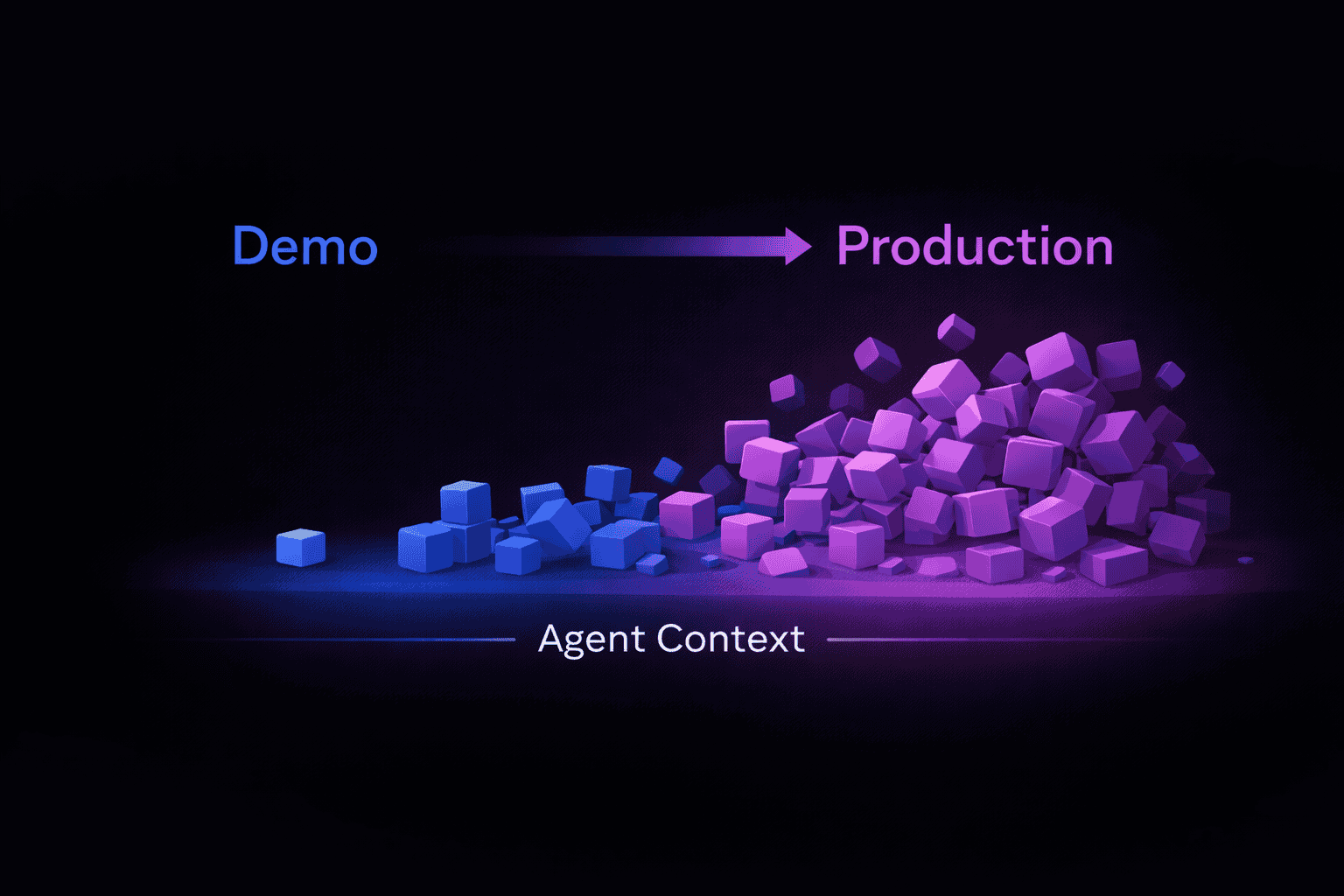
TL;DR
Agent context feels simple early on because it is short-lived and shaped by local demo assumptions.
As agents move to cloud-native production environments, context becomes a durable system state. Early storage choices, such as messages, files, and skills spread across different databases, often need to be rebuilt rather than just migrated. They quietly turn into technical debt as agents grow.
This is why context should be treated as a unified data layer from the start, rather than stitched later.
If you're building a long-running, tool-calling agent with multi-step workflows, this blog is for you.
1. Why Your Current Storage Works (For Now)
If you look at how most agents are built in the beginning, the setup is usually very simple.
Messages live in memory or a small database. Files go to local disk or S3. Skills are written directly into prompts or functions. Context editing↗ is handled with a few basic if/else rules.
This is not bad practice. It is the right way to build an agent at the demo stage. You optimize for speed, not durability.
Nothing here is wrong. A rough timeline most teams go through:
- Day 1–7
The last few messages are enough. Files are generated and used immediately, if at all. Skills run once and are rarely reused. Context is temporary, so where things live does not really matter. - Day 30
You start keeping more history. The agent does similar tasks again, and past conversations become useful. Messages grow, files accumulate, but everything still feels manageable. - Day 60
New questions show up. Can the agent reuse something it created before? Can it continue a task across runs? Context now needs to survive beyond a single execution. - Day 90
Behavior starts to feel unstable. Small prompt changes have unexpected effects. Debugging is harder because there is no single place that shows what the agent has seen and done.
This is normal. You did exactly what made sense at the time.
2. When Context Stops Being Temporary, Everything Changes
At first, it feels like you are only storing data.
Messages are conversation history. Files are outputs. Skills are just prompt text or helper code.
But those choices already shape behavior.
The problem starts when context is no longer short-lived.
- When tokens overflow, something must be removed. That choice defines what the agent forgets.
- When files are saved without clear links to conversations, reuse becomes harder.
- When skills live inside prompts, they become tied to specific flows instead of reusable capabilities.
These decisions feel small and look like implementation details.
Once context persists across runs, they start to matter. Behavior depends on past structure. Debugging means reconstructing history. Small changes have unexpected effects.
You are not just storing data anymore. You are designing how the agent behaves over time.
3. Why Context Migration Becomes Painful to Fix Later
Sooner or later, the original setup stops being enough.
This is when the first rewrite happens. Not to add features, but to ensure context persists and stays consistent across runs.
What you try to do:
- Add persistent memory
- Add reuse agent skills
- Add multi-modal support
- Switch or mix model providers
What actually happens is different.
What you run into:
- Context migration instead of simple refactoring
- LLM-specific message and multi-modal formats
- Token management logic tied to old assumptions
- Existing data that no longer fits new rules
A real example
We ran into this while adding multi-modal support and proper session persistence to an existing chatbot, Memobase Playground↗.
The goal sounds simple: support images, audio, and documents, and store conversation history reliably.
What followed was mostly context work. Different LLM providers required different message formats. Multi-modal inputs needed custom handling. Sessions required new schemas and data migrations. Token limits forced careful truncation logic to keep context coherent.
This is where the cost jumps.
What sounds like a small refactor turns into a full-blown rebuild of context infrastructure. A typical workload estimate for adding proper session persistence and multi-modal support looks like this:
Step | Time Estimate |
Database schema design | 4–6 hours |
Message storage API | 6–8 hours |
Multi-modal format handling | 8–12 hours |
Multi-provider conversion | 10–15 hours |
Token management | 4–6 hours |
Testing and edge cases | 6–8 hours |
Total | 5–7 days |
Recommend Read:
We later documented this refactor using an innovative approach and wrapped it up in a step-by-step blog post.
What would normally take 5–7 days with a traditional migration was reduced to about one day by using Acontext to handle unified context storage for model-agnostic messages and multi-modal format handling. Learn more here: https://acontext.io/blog/adding-multi-modal-support-to-a-chatbot-without-rebuilding-backend
4. A Practical Mental Model: Context as a Unified Data Layer
Treat Context as Long-Lived System State
Context should be designed as a long-lived system state.
It is not just input to the next model call. It is the accumulated record of what the agent has seen, produced, and relied on. Once stored, this history directly influences future agent behavior and cannot be freely rewritten without changing outcomes.
This is why context decisions matter more than they appear in the first place.
Store What Happened, Not What You Think You'll Need
At storage, the goal is simple: record what actually happened.
Messages, artifacts, and skill invocations should be stored as a complete history, without prematurely trimming, reshaping, or collapsing them into a specific prompt format. Early assumptions about “what will be useful later” are rarely correct.
How context is used can change over time. What happened should not.
Keep Context in One Unified Layer
Messages, artifacts, sessions, and skills should live in a single, unified data layer↗.
When these are split across databases, object storage, and ad-hoc logic, teams are forced to stitch together formats, identifiers, and assumptions as systems evolve. This stitching becomes fragile once agents move from local demos to cloud and production environments.
A unified layer does not add complexity early.
It prevents complexity from exploding later.
Let Usage Evolve Without Rebuilding Storage
Early agents do not need sophisticated context logic.
What matters is that the storage model allows context to grow: longer sessions, richer artifacts, reusable skills, and cross-run relationships — without changing how data is represented.
When storage remains stable, behavior can evolve safely. When storage changes, behavior changes unintentionally.
This distinction is what separates iteration from rewrites.
Make Context Observable and Replayable
A unified context layer enables monitoring past runs and understanding how agent tasks perform.
Not by reconstructing events from logs and side systems, but by reading the stored context directly. This enables debugging and iteration based on evidence rather than guesswork.
Design for What Will Outlive Your Code
Prompts will change.
Models will be replaced.
Code will be rewritten.
Context remains.
If an agent succeeds, its context will outlive early implementations. Designing context as a unified data layer is not an optimization. It is how teams avoid rebuilding their systems once success arrives.
At last, Acontext is our attempt to put this mental model into practice.
If it resonates, you're welcome to try it out.
Open Source here: https://github.com/memodb-io/Acontext
Cloud Service (Freemium): Dashboard | Acontext↗