Agent, Context, and Data Platform We Need
Acontext is a data platform designed to store multimodal context data, monitor agent success, and simplify context engineering.
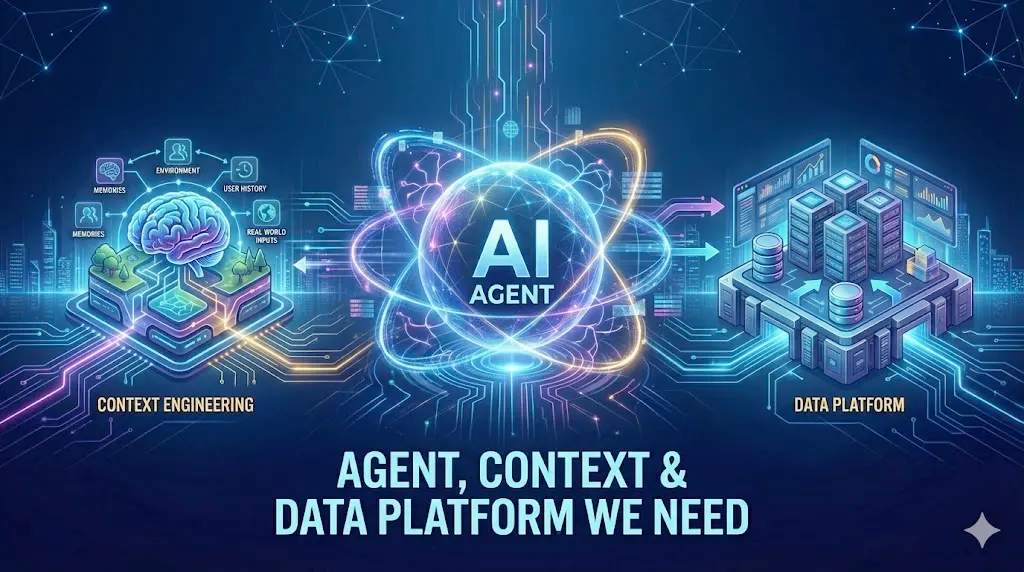
For all the talk about 'agents', the word itself has become surprisingly fuzzy. In research circles, startup decks, and engineering teams, people often refer to very different things using the same term. And that confusion hides an important truth: most systems we casually call agents today are not actually agents in any meaningful sense.
- A tool-calling LLM is not automatically an agent.
- A model wired to two predefined tools, even if it chooses when to call them, rarely feels like an agent.
And many projects that appear agent-like are, in practice, deterministic workflows disguised behind prompting.
The distinction matters, not for semantics, but because we are finally seeing real AI agents emerge, and if we want to build the next generation of systems, we must understand why some models behave like agents… and why most don't.
The Gap Between Tools and True Agents
The industry is full of examples where people script a multi-step prompt:
''First, call this tool. Then call that tool. Then summarize the result.''
This is not an AI agent. It's simply a workflow encoded through natural language.
The intuition people hold about agents points to something much more profound:
An agent should be capable of outcomes far beyond what its tools explicitly encode.
That is why Claude Code or Codex feels magical. Their tool implementations are trivial: any Computer Science intern can write a read_file, write_file, or exec wrapper. Yet no intern can outperform the model when actually coding.
Tools are mundane.
Behavior that emerges from them is not.
This gap between the simplicity of tools and the sophistication of behavior is the first real clue to what a true agent actually is.
Workflow Builders vs Agent Builders
Once you recognize this gap, the real question becomes: What separates building workflows from building agents?
It comes down to mindset.
Workflow builders think in sequences:
- What should be executed first?
- What comes next?
- What conditions trigger which branch?
Agent builders think in environments:
- What environment does my agent operate in?
- What are the atomic actions available in this scope?
- Does the combination of those actions theoretically cover the action space of a human operator?
- What guidelines shape behavior in this environment?
To build agents, you must shift from scripting procedures to designing environments.
Agents emerge not from control, but from well-constructed uncertainty.
The Heart of It All: Context Engineering
Once you step into the environment mindset, a new challenge appears: Your agent is only as capable as the context it can see, retrieve, and use, which means context, not tools, not prompts, is the real substrate of intelligence:
- Define a complete and accurate tool set
- Define human guidelines and behavioral constraints
- Determine the agent's real-time context state
- Decide what to load into context and what to offload
- Enable the agent to discover new context when needed
Today's discussion around 'context' is dominated by RAG and MCP, but search and tool schema only cover a tiny slice of the problem. Context Engineering is about managing the entire universe of information that an agent can act upon.
A helpful way to think about it is through three types of context:
In-Session Context
The live state of an ongoing interaction.
Most of the engineering work today focuses only here.
External Context
Everything the agent can discover or load: skills, files, knowledge bases, artifacts, and tool descriptions.
Claude Skills is the first industry example in which the builder community has truly embraced this idea. Claude Skills isn't a protocol, it's a way of thinking. It frames context as experience, not data, and encourages selective loading rather than building a human-like search index.
Manus follows a similar pattern in its sandbox: its terminal-use exposes discoverable tools and lets agents dynamically uncover new capabilities.
Cross-Session Context
This is what the agent has done before. Traditionally called 'memory', but memory is too weak a word.
What agents really need is experience. Check out more about its differences from memory layer↗.
Understanding and engineering these layers is the real work of agent design.
Why the Agent Era Needs a Context Data Platform
Look at the current landscape.
Developers have frameworks such as LangGraph, Agno, and n8n to orchestrate agent workflows. These tools help with execution, but not with context.
The intelligence of an agent no longer sits in the workflow.
It sits in context.
Yet we still lack a platform dedicated to:
- storing all context data
- engineering its structure
- observing agent behavior
- capturing reusable experience
- providing continuity across tasks and sessions
If context is now the source of complexity and intelligence, we need infrastructure built for it.
We need a new category—a Context Data Platform.
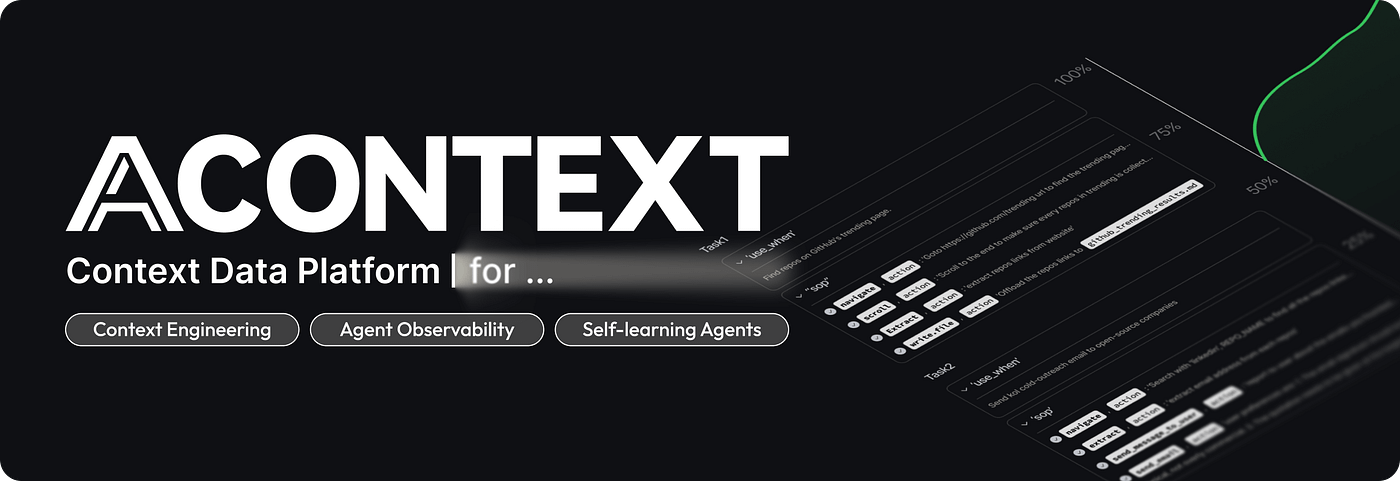
We call it Acontext↗, a platform designed to store multi-modal context data↗, to monitor agent success, and to provide a layer of certainty amid the inherent uncertainty of agent behavior.
It focuses on two core problems:
- How to move the storage and observability of context data into the cloud
- How to ensure that when a powerful agent completes a complex task right once, it can continue getting it right every time thereafter
What Lives Inside Context Data?
Acontext is built around this new category, which can manage:
Multi-Modal Messages
Messages from OpenAI, Anthropic, Gemini, and future providers: all normalized, stored, indexed, and accessible across sessions. Text, code, PDFs, images, upcoming modalities, Acontext can handle them for you seamlessly.
No more gluing Postgres, S3, Redis by hand: How Acontext Stores AI Messages?↗
Artifacts
Agents need a place to store what they produce.
Acontext's Artifact Disk offers a cloud-hosted filesystem abstraction (based on Linux file path): intuitive for agents, scalable for developers.
Plan & Task Observability
What did the agent promise?
What did it do?
Was it successful?
Acontext includes background observers that track tasks, gather user feedback, and help quantify agent success.
How to Improve Agents' Success Rates?
The logic is simple: when an agent gets something right, it should keep getting it right; when it gets something wrong, it should avoid repeating the mistake.
Acontext builds a Skill Space for capturing these execution patterns. An internal Experience Agent detects meaningful tasks, extracts the successful workflow, and stores it in a structured space so future agents can reuse it automatically.
This is not memory in the traditional sense.
It is the accumulation of SOPs: the practical know-how generated through real agent–human collaboration.
From context to skill, a further breakdown in this blog: Inside Acontext: How AI Agents Learn from Experience↗
For the Visionaries Building What Comes Next
Acontext is open source.
We're actively developing it with the community and learning from builders pushing the boundaries of agent capability.
If you see the future of agents the way we are doing, we'd love for you to explore Acontext.
GitHub: https://github.com/memodb-io/Acontext
One line of code to launch the full stack with curl -fsSL https://install.acontext.io | sh.
The agent era has entered the era of context. Let's build the infrastructure it deserves.